

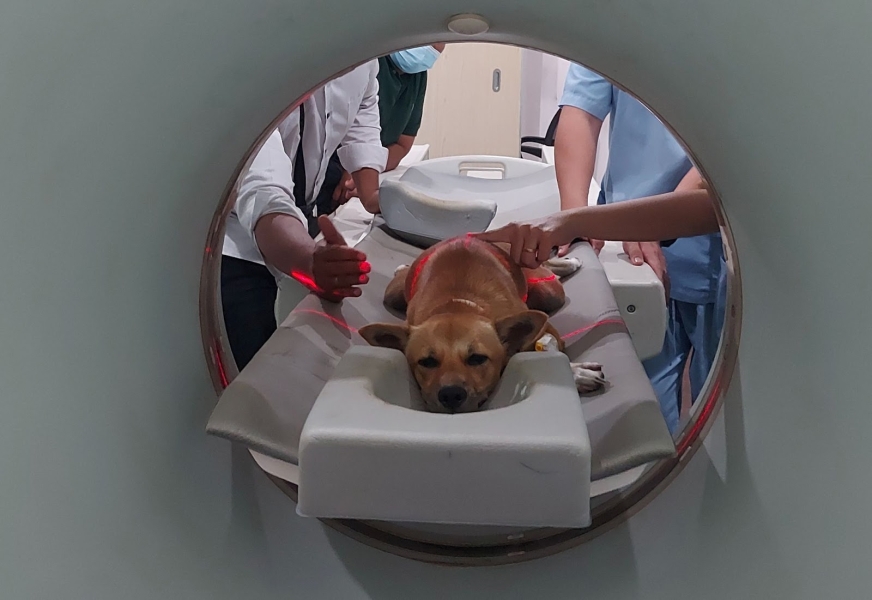
Dog CT Scans: Are They Worth the Cost? A Vet's Deep Dive
Here's a fact that might sting: sometimes, the most obvious symptoms in your dog aren't the most critical. A subtle limp could mask a hidden tumor, or a bout of sneezing might point to something far beyond a simple allergy. That's where advanced imaging like CT scans come in.
For Busy Owners: A CT scan uses X-rays to create detailed, cross-sectional images of your dog's body, helping vets diagnose tricky conditions. They are particularly useful for looking at bones, tumors, and internal organs when X-rays or ultrasound aren't enough. While CT scans are more expensive, they can provide crucial information for effective treatment.
What Exactly *Is* a Dog CT Scan?
A dog CT scan, or computed tomography, is an advanced imaging technique that provides detailed, cross-sectional views of your dog's anatomy. Unlike regular X-rays, which produce a single, flat image, a CT scan creates a series of "slices" that can be reconstructed into a 3D model. This allows for a much more thorough evaluation of bones, organs, and other internal structures.
Think of it like this: imagine slicing a loaf of bread. Each slice gives you a slightly different view of the inside. A CT scan does the same thing for your dog, allowing us to see problems that might be hidden on a standard X-ray. These images are crucial for guiding treatment decisions. For example, in cases of suspected neoplasia (cancer), a CT scan can help determine the size and location of a tumor, as well as whether it has spread to other areas (metastasis).
The Clinical Perspective (Biological 'Why')
The power of a CT scan lies in its ability to visualize structures in three dimensions. Traditional X-rays are two-dimensional, meaning that structures overlap, potentially obscuring important details. With a CT scan, we can eliminate this issue. The technology relies on the differential absorption of X-rays by different tissues. Denser tissues, like bone, absorb more radiation and appear brighter on the image, while less dense tissues, like soft organs, absorb less and appear darker. Contrast agents are often used to further enhance the visibility of blood vessels and certain organs. This is particularly useful when assessing blood supply to a tumor or identifying areas of inflammation.
Why Would My Dog Need a CT Scan? Identifying Key Reasons
Your vet might recommend a CT scan if standard imaging methods like X-rays or ultrasounds aren't providing enough information to diagnose your dog's ailment. It's not the first tool we reach for, but when we need a deeper look, CT scans are invaluable. They are also mission-critical when planning intricate surgeries.
I can recall a case in the exam room just last week, a geriatric Shepherd mix presented with chronic nasal discharge. Radiographs showed some soft tissue opacity, but a CT scan revealed a fungal granuloma eroding through the nasal turbinates. Without that level of detail, we might have misdiagnosed or mistreated the condition.
Common Conditions That May Require a CT Scan
- Tumors: CT scans are excellent for detecting and staging tumors, helping to determine their size, location, and spread. This is especially important for cancers affecting the head, neck, chest, and abdomen. The scan can help determine if the tumor is impinging on major blood vessels or organs.
- Nasal or Sinus Conditions: Chronic nasal discharge, facial swelling, or sneezing can indicate problems within the nasal passages or sinuses. A CT scan can help identify masses, inflammation, or foreign bodies that are difficult to see with other methods.
- Inner Ear Disease: Infections or tumors in the inner ear can cause severe balance problems and pain. CT scans can provide detailed images of the inner ear structures, helping to pinpoint the source of the problem.
- Traumatic Injuries: After a traumatic event like being hit by a car, a CT scan can help assess the extent of internal injuries, including fractures, bleeding, and organ damage.
- Internal Bleeding: CT scans can help identify the source of internal bleeding, which can be life-threatening.
- Complex Fractures: CT scans are useful for evaluating complex fractures, especially those involving joints or the spine.
- Back Injuries: For dogs with back pain or neurological problems, CT scans can help identify herniated discs, spinal cord compression, or other spinal abnormalities.
The Clinical Perspective (Biological 'Why')
The need for a CT scan often arises when simpler diagnostic methods fall short. For example, in cases of suspected tumors, a CT scan can provide crucial information about the tumor's size, shape, and location, as well as whether it has spread to nearby tissues or organs. Biologically, this is vital because the spread of cancer cells (metastasis) depends on factors like angiogenesis (the formation of new blood vessels to feed the tumor) and the tumor's ability to disrupt the extracellular matrix, allowing cancer cells to invade surrounding tissues. A CT scan helps us visualize these processes and make informed decisions about treatment.
What Are the Benefits of a Dog CT Scan?
Compared to other imaging techniques, dog CT scans offer some serious advantages. The 3D imaging capabilities, fine detail, deep structure assessment, and wide availability make it a powerful veterinary tool.
- Three-Dimensional Images: Unlike X-rays, which create two-dimensional images, CT scans provide three-dimensional reconstructions. This eliminates the superimposition of structures, allowing for a more accurate assessment of the anatomy.
- Fine Detail: CT scans offer superior detail compared to X-rays, allowing for the detection of subtle abnormalities.
- Deep Structure Assessment: CT scans can visualize structures that are difficult to assess with other methods, such as the sinuses or inner ear.
- Availability: CT scans are more widely available and generally less expensive than MRIs.
The Clinical Perspective (Biological 'Why')
The effectiveness of a CT scan boils down to its ability to provide high-resolution images of internal structures. This is achieved through the use of X-rays, which interact with tissues based on their density. The degree of X-ray attenuation (the reduction in intensity as the X-rays pass through tissue) is measured by detectors, and this data is used to create the cross-sectional images. The use of contrast agents further enhances the visibility of blood vessels and certain organs. For example, iodine-based contrast agents are often used to assess kidney function or to highlight areas of inflammation. The biological rationale here is that areas of inflammation typically have increased blood flow and vascular permeability, leading to greater contrast enhancement.
What Are the Potential Risks Associated with a Dog CT Scan?
While generally safe, CT scans aren't entirely risk-free. The primary concerns revolve around anesthesia, the potential for incidental findings, and radiation exposure. We always weigh these risks against the potential benefits before recommending the procedure. It's a non-negotiable part of my job.
- Adverse Effects from Anesthesia: Anesthesia always carries a risk, although serious complications are rare.
- Accidental Discovery of a Harmless Abnormality: Sometimes, a CT scan reveals a minor abnormality that is not clinically significant but leads to further, unnecessary testing.
- Radiation Exposure: While the radiation dose from a single CT scan is relatively low, repeated exposure to radiation can increase the risk of cancer over time.
The Red Flag Checklist (When to Panic vs. When to Wait)
- Difficulty Breathing After Anesthesia: This is an emergency. Seek immediate veterinary care.
- Prolonged Vomiting or Diarrhea: Contact your veterinarian if your dog experiences persistent gastrointestinal upset after the CT scan.
- Signs of Allergic Reaction: Hives, facial swelling, or difficulty breathing could indicate an allergic reaction to the contrast agent. Seek immediate veterinary care.
- Lethargy or Weakness: Mild lethargy is common after anesthesia, but prolonged weakness or unresponsiveness is cause for concern.
What Will a Dog CT Scan Cost Me?
The cost of a dog CT scan can vary quite a bit, typically ranging from $1,500 to $3,500. The final price depends on the body area being scanned, whether it's an emergency procedure, the type of machine used, local veterinary costs, and the duration of anesthesia.
Home-Care Hacks (Low-cost, practical tips)
- Shop Around: Get quotes from multiple veterinary hospitals to compare prices.
- Ask About Payment Plans: Some hospitals offer payment plans or financing options to help manage the cost.
- Consider Pet Insurance: If you have pet insurance, check to see if it covers CT scans.
- Discuss Alternatives: Talk to your veterinarian about whether there are less expensive imaging options that might provide the information needed.
How Do I Prepare My Dog for a CT Scan?
The good news is that at-home preparation for a dog CT scan is usually minimal. Your vet will likely advise you to fast your dog after midnight the night before the procedure, but water is generally okay until the appointment. They may also run blood work to ensure your dog is healthy enough for anesthesia.
The Clinical Perspective (Biological 'Why')
Fasting before anesthesia is mission-critical to minimize the risk of aspiration pneumonia. When a dog is anesthetized, their gag reflex is suppressed, making them vulnerable to inhaling stomach contents into their lungs. Aspiration pneumonia is a serious and potentially life-threatening condition that can result in severe inflammation and infection in the lungs. The biological mechanism here is that the acidic stomach contents cause direct damage to the lung tissue, triggering an inflammatory response. Additionally, the presence of bacteria in the aspirated material can lead to a bacterial infection. Ensuring an empty stomach significantly reduces the risk of this complication.
What Are Some Alternatives to a Dog CT Scan?
Alternatives to CT scans include other imaging modalities like MRI or nuclear scintigraphy (bone scanning). However, each procedure comes with its own set of risks and benefits. X-rays and ultrasounds are more affordable but may not offer the level of detail needed for diagnosis.
The Clinical Perspective (Biological 'Why')
The choice of imaging modality depends on the clinical question being asked. For example, MRI excels at visualizing soft tissues, such as the brain and spinal cord, because it relies on the magnetic properties of water molecules in the body. Different tissues have different water content and respond differently to the magnetic field, allowing for high-resolution images with excellent soft tissue contrast. In contrast, CT scans are better for visualizing bone because they rely on the absorption of X-rays by dense tissues. Nuclear scintigraphy, or bone scanning, involves injecting a radioactive tracer that is absorbed by bone tissue. Areas of increased bone turnover, such as fractures or tumors, will show up as "hot spots" on the scan. Each technique provides unique information, and the choice depends on the specific diagnostic needs of the case.
Dog CT Scan FAQs
Is it worth getting a CT scan for a dog?
Deciding whether to get a CT scan for your dog is personal, based on your resources and preferences. Vets often find CT scans invaluable for guiding treatment plans.
How much should a CT scan on a dog cost?
CT scans for dogs typically range from $1,500 to $3,500 due to the anesthesia required.
Does a dog need to be sedated for a CT scan?
Yes, dogs must be anesthetized during a CT scan for safety, comfort, and to prevent movement.
What happens when a dog has a CT scan?
During a CT scan, dogs are anesthetized and placed in a scanner that uses radiation to create cross-sectional images of the targeted body part.