

Decoding Doggy Pointing: Canine Cognition, Training, and the Power of Non-Verbal Cues
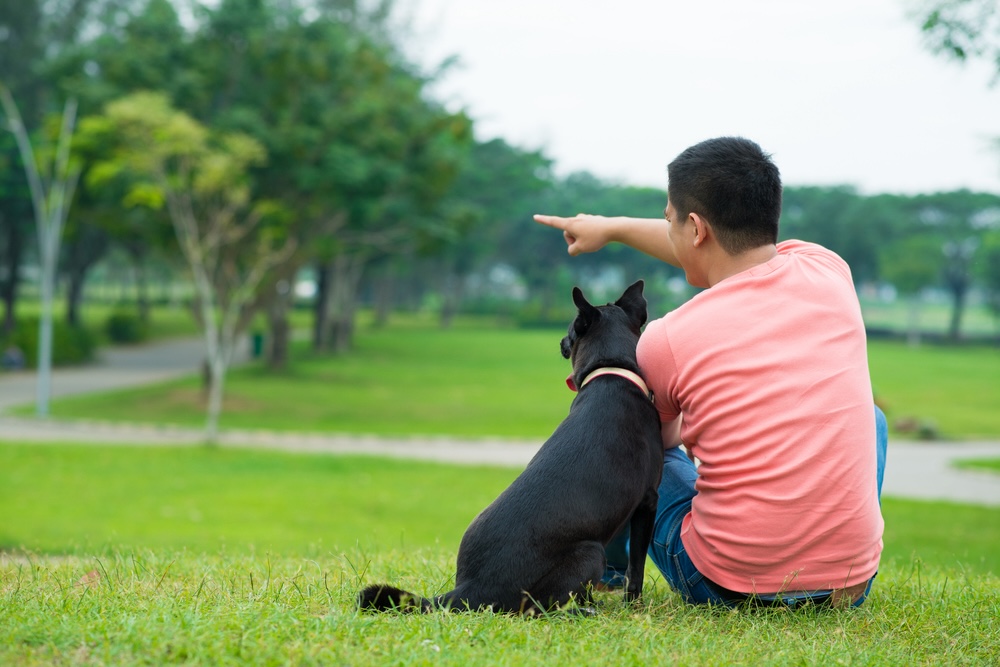
Here's a brain-tickler: Dogs are better at understanding human pointing gestures than chimpanzees. I know, right? It flies in the face of everything we assume about primate intelligence. But before you start thinking your furry friend is ready for Mensa, let's unpack what this actually means.
For Busy Owners: Research indicates dogs understand pointing gestures, particularly when paired with verbal cues and positive reinforcement. Domestication has likely primed them to interpret human signals. Incorporating hand signals into training can significantly improve communication and obedience.
The Domestication Factor: How Did Dogs Evolve to Understand Pointing?
Domestication plays a mission-critical role in a dog's ability to understand pointing. Unlike wolves, even those raised by humans, domestic dogs show an innate understanding of this gesture from a young age. This isn't just about Lassie understanding commands; it's about a fundamental shift in how their brains process information. This advantage likely stems from selective breeding, where humans favored dogs that were more responsive to social cues. Think about it: early humans needed dogs that could quickly understand instructions for hunting and guarding. The biological mechanism at play here involves heightened sensitivity to human social signals, possibly through changes in gene expression related to social cognition. I remember one case in the exam room, a husky mix who seemed utterly disinterested in verbal commands, but the moment the owner used a hand gesture, boom, instant compliance. It's like they're hardwired for it.
Supporting Evidence: What Does the Science Say About Canine Cognition and Pointing?
Scientists have rigorously investigated how dogs interpret pointing, revealing nuances that go beyond simple stimulus-response. One study highlighted that dogs respond best to pointing when performed by a real person, not a 2D representation. This suggests that dogs aren't just reacting to the gesture itself, but also to the social context and the person delivering the cue. Biologically, this could involve activation of mirror neurons in the dog's brain, allowing them to simulate the actions and intentions of the human. Mirror neurons, if you remember from vet school, are thought to be fundamental in understanding social behavior. Another interesting finding: dogs interpret pointing more effectively when objects are farther apart. This implies that they're actively problem-solving and using spatial cues to understand what the human is indicating.
Adding Verbal Cues to the Mix: The Power of Combined Communication for Dog Owners
The most effective way to teach a dog is to pair pointing with verbal cues. This mirrors how we teach children language, associating a word with a physical object or action. Researchers have found that dogs can learn to associate a spoken word with a specific object when it's paired with pointing. This creates a powerful link in the dog's brain, solidifying their understanding. Think of it like this: the verbal cue acts as a label, while the pointing gesture provides the context. I tell my clients to always use both. For example, when teaching a dog to fetch a ball, say "ball" while pointing at it. The biological basis for this lies in the dog's ability to form associative memories, strengthening the neural connections between the word, the gesture, and the object.
Do Dogs View Pointing as a Command? Exploring Canine Theory of Mind
Here’s the deal: dogs can discern the intent behind pointing gestures, suggesting they possess a rudimentary "theory of mind." Studies have shown that dogs can differentiate between a person pointing at an empty bowl versus one containing food, and they're more likely to respond to the latter. Even more fascinating, they seem to recognize when a person is providing false information. This suggests that dogs aren't just blindly following instructions; they're actively evaluating the situation and making judgments about the person's intentions. The biological underpinnings of this behavior are complex, but it likely involves activation of the prefrontal cortex, the brain region responsible for higher-level cognitive functions such as decision-making and social cognition.
Using This Science When Training Our Pets: Practical Tips for Dog Owners
Understanding how dogs interpret pointing can revolutionize your training approach. Incorporating hand signals alongside verbal commands can significantly improve communication and obedience. For instance, use a specific hand gesture for "sit," "stay," or "come," pairing it with the corresponding verbal cue. Consistency is non-negotiable here. The biological principle at play is classical conditioning: by repeatedly pairing a hand signal with a verbal command and a reward, you create a strong association in the dog's brain. This makes the behavior more likely to occur in the future.
Home-Care Hacks:
- Start early: Begin training with hand signals as early as possible, ideally during puppyhood.
- Keep it simple: Use clear, distinct hand gestures that are easy for your dog to understand.
- Be consistent: Use the same hand signals and verbal cues every time you give a command.
- Reward success: Positive reinforcement, such as treats or praise, is essential for reinforcing desired behaviors.
The Red Flag Checklist:
- Sudden loss of understanding: If your dog suddenly stops responding to hand signals or verbal cues they previously understood, it could indicate a medical issue. See your vet.
- Difficulty learning new signals: If your dog struggles to learn new hand signals despite consistent training, it could be a sign of cognitive decline.
- Ignoring cues in familiar environments: If your dog only responds to cues in certain environments but not others, it could indicate anxiety or stress.
Final Thoughts: Canine Cognition and the Human-Animal Bond
Honestly, the more we learn about canine cognition, the more respect we should have for these incredible animals. Their ability to understand pointing gestures is just one example of their remarkable intelligence and their capacity for social connection. By understanding how dogs think and learn, we can build stronger, more fulfilling relationships with them. And that, my friends, is what it's all about.