The air in the bakery that afternoon was heavy with the silence of a finished day, a quiet so complete it seemed to hold its breath. The familiar scents of yeast and sugar lingered like ghosts, warming the cooled ovens. I was counting down the minutes to closing when the door’s chime shattered the stillness.
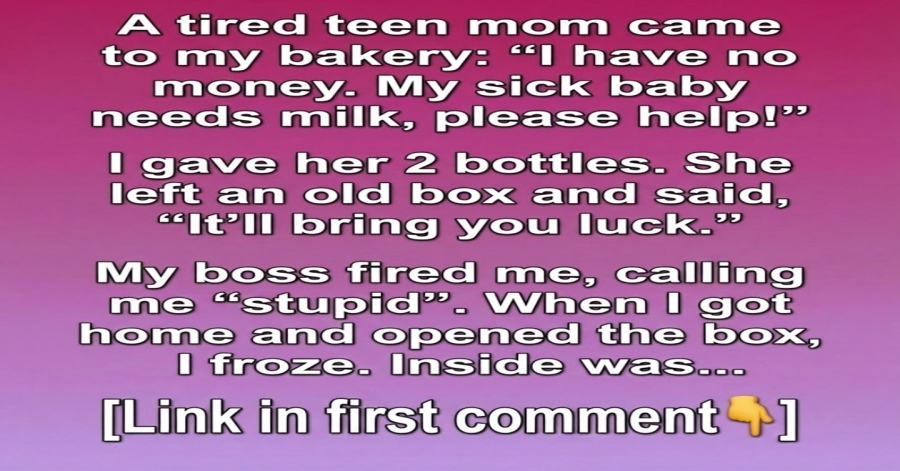
She entered as if crossing a threshold into a church—reverent, uncertain. She was young, her face pale beneath a halo of exhaustion no sleep could mend. Clutched to her chest, wrapped in a thin blanket, was a sleeping baby. Her eyes met mine, and the words tumbled out in a frayed whisper.
"I’m sorry. I have no money. But my baby… she needs milk.”
There was no artifice in her voice, only a truth worn bare. I didn’t hesitate. I took two bottles from the cooler and set them on the counter.
"Please, one is enough,” she insisted, her voice trembling.
"Take both,” I said. "For later.”
Her hands shook as she accepted them. A silent sob escaped her, tears tracing paths down her cheeks. She thanked me, a fragile mantra, and then, from a worn bag, she retrieved a small, time-softened box.
"It’s not worth anything,” she said, placing it carefully before me. "But it was my grandmother’s. She said it held luck.” Before I could refuse, she was gone, swallowed by the gathering dusk.
My manager emerged moments later, his anger immediate and absolute. "You gave away product?” he demanded. My explanation—a hungry child, a desperate mother—meant nothing. "This is a business,” he snapped. "Clean out your locker. You’re done.”
The walk home was a blur. I had traded my job for an act of simple kindness, and the world felt cold for it. It wasn’t until that night, in the hollow of my apartment, that I remembered her box.
Inside, I found no trinket, but a legacy. Neatly folded were her grandmother’s recipes, sketches of loaves and pastries drawn with a baker’s love, and certificates from forgotten classes. At the bottom, a note on a slip of paper:
*Thank you for seeing us.*
Beneath it, a phone number, and four more words: *In case you ever need help too.*
I understood then. This was not payment; it was an exchange of trust. It was a story of interupted dreams, passed from one baker’s hands to another’s.
The next morning, I didn’t look for a new job. I called the number.
Weeks later, we stood together at a market stall, flour dusting our sleeves, the air rich with the scent of baking bread. Her grandmother’s recipes. My experience. One borrowed oven.
People came for the bread. They stayed for the story.
Losing everything that afternoon felt like an ending. But it was a silent pivot, an unasked-for new beginning. The old box didn’t contain luck, not as a charm or a promise. It held a connection, patiently waiting to be found.
And that, it turns out, can be enough to change everything.