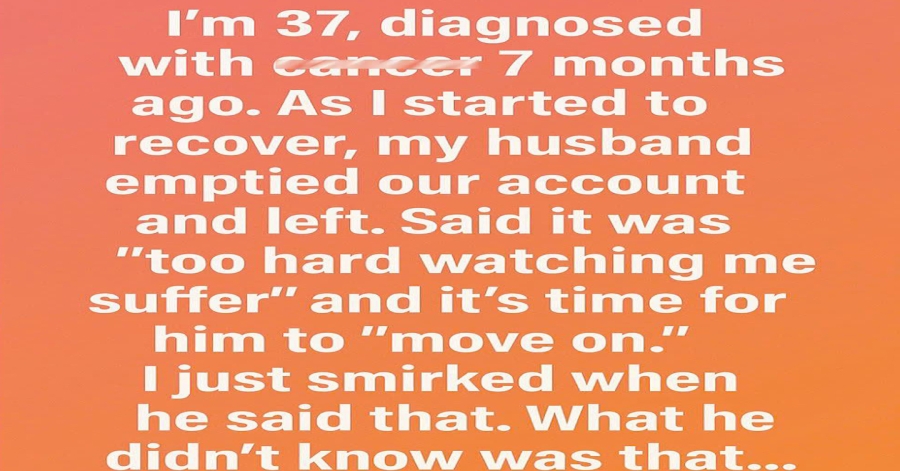
At thirty-seven, Elena understood that life changes you without asking.
Seven months before, she’d entered a doctor’s office expecting reassurance and left with a diagnosis that rearranged her future. Her calendar became a ledger of treatments and appointments. Workdays dissolved into fatigue. Conversations faded into silence. Nights grew long and heavy with unspoken fear.
Through it all, she clung to one certainty: love would not abandon her.
Mark, her husband of nine years, promised to stay. He held her hand in sterile rooms and whispered, "We’ll face this together,” until his words became the walls that held her up. She trusted him completely.
The treatments were brutal, but Elena endured. Slowly, her body began to respond. When the worst passed, small hopes resurfaced—returning to work, a weekend trip, planting flowers in spring. They were quiet dreams, but to her, they meant life was still possible.
Then, one afternoon, Mark came home early. He didn’t kiss her hello. He sat down, stiff and distant, and she felt the shift before he spoke.
His words were careful, rehearsed. Watching her suffer had been "too hard,” he said. He was "no longer the same person.” He needed to "move on.” Almost as an afterthought, he mentioned he’d emptied their joint account. He needed the money to start over. Without her.
The air left the room.
Elena waited for tears, for anger, for collapse. Instead, a strange calm washed over her. She looked at him and smiled—a small, steady smile he couldn’t understand. To him, it may have looked like surrender. It was not.
What Mark never knew was that Elena had already faced her deepest fears long before he chose to walk away.
During her treatment, a counselor had urged her to prepare for every outcome, even the unthinkable. And so, quietly, Elena had. She’d secured her documents, opened separate accounts, and built a network of people who wouldn’t vanish when things grew difficult. The account Mark took was only what she had let him see.
Within days of his leaving, she met with a lawyer. Then a financial planner. Step by step, she rebuilt not just a plan, but her own authority. The fear that once gripped her gave way to a clear, steady determination.
Months later, Elena sat by a sunlit window in an apartment she’d chosen herself. It was modest, but it was hers. Her health was improving. She was working again. Laughter had returned, tentatively, like a visitor relearning the way.
She no longer saw herself as a woman abandoned in illness.
She was a woman who had survived diagnosis, betrayal, and terror—and had emerged, quietly, unbreakably, whole.
Sometimes she wondered if Mark ever thought of that final afternoon. If he remembered her smile. If he realized what he’d truly left behind.
If he did, she hoped he understood:
He left when things became hard.
She learned to rise when everything fell apart.
And in that rising, she didn’t just rebuild her life—she finally claimed it.