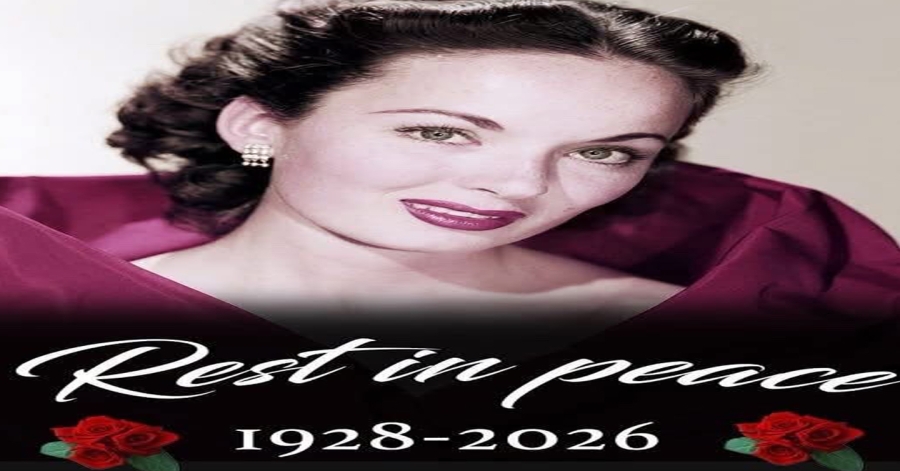
Ann Blyth, one of the last surviving stars from the Golden Age of Hollywood, passed away in June 2026 at the age of 98 . She left behind a remarkable legacy that began in childhood and spanned over five decades . While she graced the screen in musicals, dramas, and even fantasies, she will forever be remembered for one iconic, scene-stealing role: Veda Pierce, the scheming daughter from hell in *Mildred Pierce* .
## From Radio to Hollywood
Born Anne Marie Blythe in Mount Kisco, New York, in 1928, Blyth was drawn to performing from a remarkably young age. She began singing on the radio at just five years old to help support her family after her father left, later training with the San Carlo Opera Company . Her stage presence was evident early on; at only 13, she made her Broadway debut in Lillian Hellman's *Watch on the Rhine* .
While touring with the play in Los Angeles, the young actress was spotted by a Universal Studios executive. This led to a contract and a string of light musical comedies in 1944. But it was a loan-out to Warner Bros. that would change everything .
## The Breakthrough in Mildred Pierce
Cast against her sweet, demure type, the 16-year-old Blyth was given the role of Veda Pierce in the 1945 film noir *Mildred Pierce* . She played the ambitious, ungrateful, and manipulative daughter of Joan Crawford's hard-working protagonist . Her performance was so chillingly effective that it earned her an Academy Award nomination for Best Supporting Actress .
Film historian Alan Rode later described her character as "the epitome of the film noir daughter from hell" . The role was demanding; in a pivotal scene, Blyth had to slap Crawford across the face. Despite the characters' intense rivalry, Blyth later recalled that she and Crawford got along well and that Crawford even helped her with the screen test for the part .
## A Setback and a Stellar Career
The immense success of *Mildred Pierce* was quickly followed by a devastating setback. Just five days after wrapping the film, Blyth broke her back in a tobogganing accident. Doctors predicted she might never walk again, but after spending seven months in a body cast and another seven in a wheelchair, she defied the odds and made a full recovery .
Her resilience paid off. She resumed her career with a string of successful films, demonstrating her range as an actress. She played the wife of Burt Lancaster in the gritty prison drama *Brute Force* (1947) and a romantic, singing mermaid opposite William Powell in the comedy *Mr. Peabody and the Mermaid* (1948) .
## Musical Stardom and Later Life
In the 1950s, Blyth's operatic soprano voice was showcased in a series of lavish MGM musicals. She starred opposite Mario Lanza in *The Great Caruso* (1951) and with Howard Keel in *Rose Marie* (1954) and *Kismet* (1955) . Her final film role was in *The Helen Morgan Story* (1957), a biopic where, ironically, her beautiful voice was dubbed by Gogi Grant .
Blyth retired from films at the end of the decade, choosing to focus on her family. She married Dr. James McNulty in 1953, and they had five children together, remaining married until his death in 2007 . She continued to appear on stage and in television shows like *The Twilight Zone* and *Murder, She Wrote* before retiring for good in 1985 . She received a star on the Hollywood Walk of Fame in 1960 .
Ann Blyth's career was a testament to her talent, versatility, and remarkable strength. While she will always be remembered as the scheming Veda, her legacy is that of a true Golden Age star who shone brightly in both drama and song.