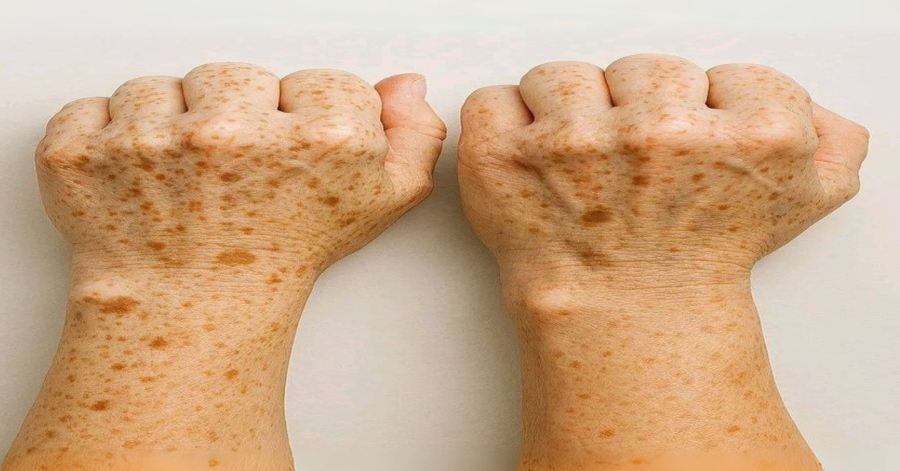
As we age, our skin naturally undergoes changes. Among the most visible signs, particularly on sun-exposed areas like the hands, face, and shoulders, are small brown patches commonly known as age spots or liver spots. While often viewed as a simple cosmetic issue, these marks can sometimes indicate more than just the passage of time. Understanding the difference between a normal spot and one that requires medical attention is essential for maintaining both your peace of mind and your health.
**What Causes Age Spots?**
Age spots are flat, oval areas of brown or dark pigmentation that result from prolonged exposure to the sun. Ultraviolet (UV) radiation accelerates the production of melanin, the natural pigment that gives skin its color. Over many years, this excess melanin can clump together and rise to the surface, forming visible spots. They are most common in adults over 50, but younger individuals who have had significant sun exposure or used tanning beds can also develop them.
Generally, these spots are harmless and do not cause pain, itching, or any physical discomfort. Many people choose to accept them as a natural part of aging, while others opt for cosmetic treatments like creams, chemical peels, laser therapy, or cryotherapy to minimize their appearance.
**Identifying Normal Age Spots**
Your spots are likely benign age spots if they are:
* Flat, smooth, and uniform in color (ranging from light tan to dark brown)
* Consistently shaped, typically oval or round
* Located on sun-exposed areas like the face, hands, arms, and shoulders
* Stable and not changing over time
In these cases, they are simply a natural sign of cumulative sun exposure and aging.
**When to Seek Medical Advice**
It is important to distinguish between harmless pigmentation and potential warning signs of skin cancer, such as melanoma. You should consult a dermatologist if you notice a spot that displays any of the following characteristics:
* **Rapid Change:** A spot that grows quickly or darkens noticeably over weeks or months.
* **Irregular Borders:** Jagged, notched, or blurred edges instead of smooth, well-defined ones.
* **Varied Color:** A mix of shades, including black, brown, red, white, or blue, within a single spot.
* **Unusual Texture:** A spot that becomes raised, rough, scaly, or one that bleeds or crusts.
* **Pain or Itchiness:** Any spot that causes persistent discomfort, itching, or tenderness.
Dermatologists recommend using the "ABCDE rule” to monitor spots for melanoma:
**A**symmetry, **B**order irregularity, **C**olor variation, **D**iameter larger than 6mm, and **E**volving over time. Any spot that meets these criteria should be evaluated by a professional.
**Prevention and Skin Care**
Even if your current age spots are harmless, protecting your skin is crucial to prevent new spots and reduce the risk of skin cancer. Effective strategies include:
* Applying a broad-spectrum sunscreen with SPF 30 or higher every day.
* Wearing protective clothing, such as wide-brimmed hats and long sleeves, when outdoors.
* Avoiding tanning beds entirely.
* Using moisturizers to maintain overall skin health.
For those bothered by the appearance of existing age spots, a dermatologist can recommend safe and effective treatment options, including prescription bleaching creams, retinoids, or in-office procedures like laser therapy.
**Conclusion**
Age spots are a common and normal part of the aging process for many people, serving as a visual record of a lifetime of sun exposure. While they are typically harmless, vigilance is key. Monitoring your skin for any changes in size, color, or texture ensures that any potential issues are caught early, allowing you to maintain healthy skin for years to come.