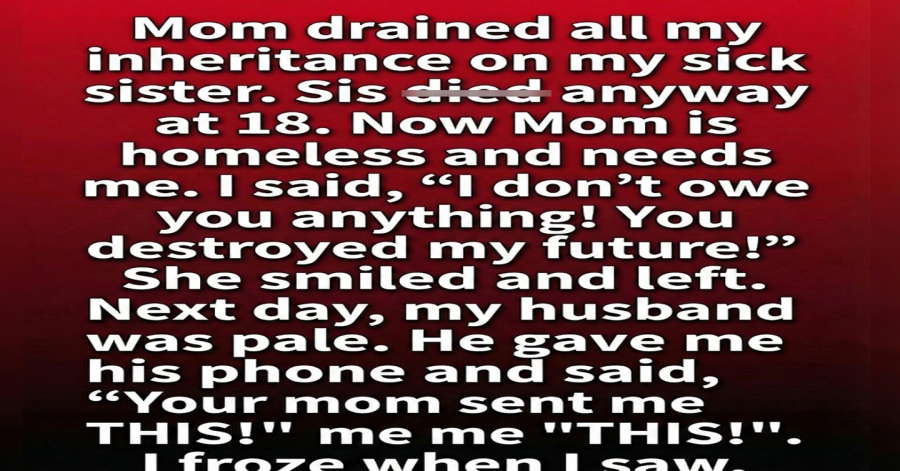
Mara was taught that love meant limitless giving, a lesson that came at a price. When her younger sister fell gravely ill, their mother devoted everything to her care—selling possessions, emptying accounts, and quietly redirecting what Mara had always believed was her own inheritance. Mara watched her imagined future dissolve as medical debts mounted and hope faded. Her sister died just after turning eighteen, and Mara’s grief slowly hardened into resentment.
So when her mother appeared at her door months later—frail, carrying all she owned in one bag—Mara’s bitterness overflowed. She accused her mother of taking too much, of ruining her life. Her mother offered no defense, only a gentle, weary smile before turning away.
The next morning, Mara’s husband handed her his phone, his face pale. An overnight message from an unknown number showed a photo: a neatly folded document beside a small silver locket that had once belonged to Mara’s sister. Below it, a note read:
"I never used your inheritance. I spent only what was mine. The account is still in your name. I kept the locket for when you were ready.”
Beneath was an address, written as if in haste.
Guilt-stricken and frantic, Mara rushed to the address—a modest shelter on the town’s outskirts. The receptionist recognized the name but would not meet her eyes. "She left early this morning,” she said softly. "She didn’t say where.” Mara searched nearby streets, made calls, followed faint clues, but her mother had vanished. Only the locket remained, waiting for her at the front desk.
Later, accessing the inheritance account, Mara discovered the full truth. Not only was the original sum intact—small deposits had been added over the years, each labeled: "For Mara’s education,” "For Mara’s marriage,” "For Mara’s future.” Her mother had not taken from her; she had quietly protected her, at great personal cost.
Now, the locket rests on Mara’s nightstand. She volunteers at shelters, leaving meals, warm clothes, and unmarked envelopes with a little money inside. She searches faces everywhere, hoping for a glimpse of a familiar, tired smile. And every night, before sleep, she whispers an apology into the dark—a message sent out on hope, waiting to be heard.