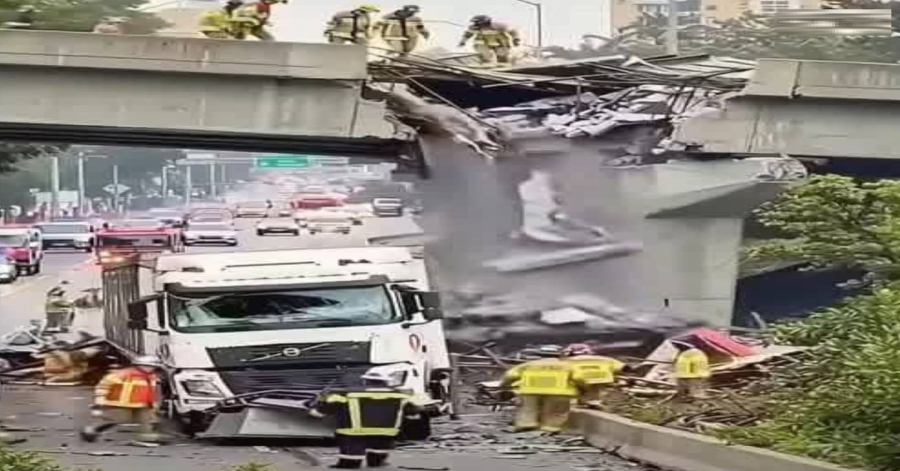
A commercial truck collision with the Cambie Road overpass on Knight Street Bridge disrupted Friday morning traffic in Richmond, British Columbia, prompting an immediate closure of all southbound lanes and a full structural inspection of the affected span.
The incident occurred around 7:15 a.m. PT when a truck towing a dump trailer in a raised position attempted to pass beneath the overpass. The trailer failed to clear the structure, struck the concrete span, and became wedged against it. The impact detached the cab from the trailer, which came to rest a short distance away. No injuries were reported, but the force of the collision raised immediate concerns about the bridge’s stability.
City engineers and provincial officials from the Ministry of Transportation and Infrastructure arrived swiftly to assess potential damage. Although the highway falls under provincial jurisdiction, the City of Richmond confirmed that municipal engineers joined the investigation to support the review. By late morning, the trailer remained pinned against the overpass as crews worked to clear debris and stabilize the area. Police advised motorists to seek alternate routes, noting significant congestion caused by the lane closure.
The Richmond Road Safety Unit (RSU) is leading the investigation in collaboration with the ministry, conducting a detailed engineering assessment that includes checking for cracks, joint displacement, and weakened support beams. Structural engineers emphasize that even visible damage may mask internal strain, requiring non-destructive testing and load simulations before the bridge can safely reopen.
This incident is not an isolated case in British Columbia. Provincial data show a rising trend of over-height commercial vehicles striking bridges across the Lower Mainland and Fraser Valley. Last year alone, a similar crash in Langley marked the eighth such collision on provincial highways. Common causes include raised truck beds, improperly measured loads, and inadequate awareness of height restrictions. Industry experts also point to aging infrastructure and inconsistent signage, citing cases where clearance markers were missing or inaccurate, or where road resurfacing inadvertently reduced vertical clearance.
The British Columbia Trucking Association (BCTA) has renewed calls for a comprehensive safety strategy, including the installation of over-height detection systems using laser or infrared sensors at key locations to warn drivers before they approach low overpasses. The association also stresses the need for improved driver training, urging fleet operators to enforce pre-trip inspections, verify trailer bed positions, and confirm height limits before travel.
Transportation experts advocate for data-driven prevention, tracking overpass incidents to identify high-risk corridors and guide infrastructure investments. Structural engineers warn that each strike must be treated as a potential safety threat, as impacts can strain internal reinforcements and compromise long-term durability, even when damage is not immediately visible.
The closure of Knight Street Bridge—a critical artery connecting Vancouver, Delta, and the Fraser Valley—has broader economic and logistical repercussions. Delays in commercial trucking increase fuel costs, disrupt supply chains, and add hours to commuter routes as traffic diverts to secondary roads like No. 5 Road and Shell Road. Repair costs for similar incidents have reached millions, often borne by insurance and public infrastructure budgets.
To mitigate future risks, experts propose a multi-layered approach combining technology, training, and infrastructure audits. Over-height detection sensors, real-time GPS fleet monitoring, regular safety programs for drivers, and periodic reviews of clearance signage and bridge elevations are all recommended. Transportation engineer Dr. Steven Fong of the University of British Columbia notes that no single tool can eliminate accidents, emphasizing that effective prevention requires a shared culture of accountability among drivers, fleet operators, and highway authorities.
The Richmond crash adds to a growing national conversation about Canada’s transportation safety priorities. As freight volumes increase and commercial vehicles grow larger, modernizing aging bridges and overpasses becomes increasingly urgent. Policymakers are considering mandating over-height detection on major corridors and integrating clearance databases into truck navigation systems to reduce reliance on manual signage.
While the Knight Street collision caused no physical harm, it underscores a recurring challenge that demands systematic attention. Proactive investment in detection systems, rigorous inspection protocols, and sustained education within the trucking industry are essential to preventing future disruptions. By approaching road safety as a shared responsibility—combining technology, enforcement, and awareness—communities can protect both lives and livelihoods on critical transportation routes.