Last Wednesday marked my grandparents’ fiftieth wedding anniversary. Though my grandfather, Walter, passed away two years ago, my grandmother, Doris, still honors their love in small, meaningful ways. This year, she wore the navy blouse and pearl brooch he had given her and visited the same restaurant where they had celebrated every year. For one evening, she could feel close to him again.
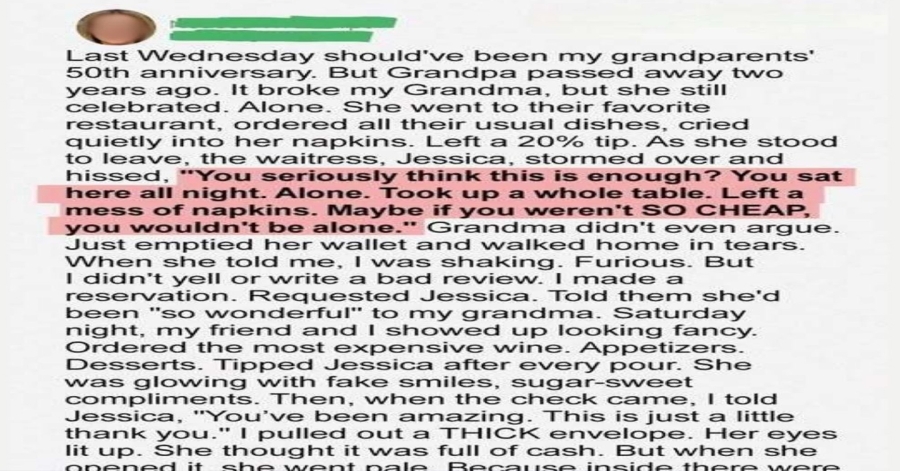
She had saved just enough for the bus fare and their usual meal, leaving a twenty percent tip—all she could afford. But instead of kindness, she was met with cruelty. Her server, Jessica, sneered at her for dining alone "at her age" and loudly shamed her for the "insufficient" tip. Humiliated, my grandmother gathered her things and walked eight blocks home in tears.
When she told me what happened, my anger burned—not for revenge, but for accountability. I wanted Jessica to *understand* the pain she caused, not just face another anonymous online rant.
So, I made a reservation at the same restaurant and requested Jessica as our server. My friend Jules, a photographer, joined me. We dressed elegantly, ordered the most expensive dishes, and played the part of generous diners—letting Jessica assume she’d be rewarded for her service.
When dessert arrived, I handed her an envelope. Inside were napkins with messages my grandmother couldn’t say that night:
*"You should be ashamed."
"She is not a wallet; she is a widow."
"Karma is on its way."*
I watched her face as she read each line, the realization dawning. Calmly, I recounted what had happened—the anniversary, the blouse, the walk home in tears. My voice never wavered. This wasn’t about screaming; it was about making sure she *felt* the weight of her cruelty.
Jessica didn’t smile this time. Whether she changes or not, she can never again claim ignorance. Some wounds don’t heal with an apology—but at least now, she knows.